
You hit the remote on your way out and nothing happens. You try the wall button inside the garage, still nothing, or maybe the opener hums but the door just sits there. You check the breaker, try again, and start wondering if you're now stuck parking in the driveway through hurricane season. Before you assume the worst, it helps to know what's actually going on, because a stuck door almost always points to one of a handful of causes, and they tend to show up in a predictable order.
What You're Actually Seeing When the Door Won't Budge
Not every "won't open" problem looks the same, and the specific symptom is the first clue to the cause:
- Total silence — no light, no hum, no motor sound at all when you press the remote or wall button.
- The opener hums or clicks but the door doesn't move — power is reaching the unit, but something downstream is blocked.
- The door opens a few inches, then stops or reverses — usually a sensor or limit issue, not a power problem.
- The door won't move even by hand — this almost always means a spring or cable failure, because a properly working door should lift fairly easily when disconnected from the opener.
- One side lifts faster than the other, or the door looks crooked — a track, roller, or cable problem on one side.
The Check Order: What a Technician Looks at First
Diagnosing a stuck door isn't guesswork. There's a logical sequence, starting with the simplest, cheapest explanations and moving toward the ones that need parts and tools.
1. Power to the Opener
First stop is always the outlet and breaker. Garage outlets are frequently on GFCI circuits, and Southwest Florida humidity is notorious for tripping them, especially after a heavy afternoon downpour pushes moisture into the garage. A tech checks the outlet, the breaker panel, and whether the opener's own light is on at all before touching anything else.
2. Remote and Wall Switch
Dead remote batteries are common enough that it's always checked early. If the wall-mounted switch inside the garage also fails to trigger the door, that points to a wiring issue between the switch and the opener rather than the remote itself.
3. Photo-Eye Sensors
These small sensors near the bottom of the tracks have to see each other in a clear, unbroken beam or the opener won't close or in some cases won't run the door at all. Misalignment from a bump, a cobweb across the lens, condensation, or grime from storm splash-back can all block the beam. The fix is usually just realigning and wiping the lenses, but a bent bracket may need adjusting too.
4. Manual Disconnect Cord
That red cord hanging from the trolley disengages the door from the opener for manual use. If it's been pulled accidentally, or a previous power outage during storm season led someone to use it and never reset it, the opener will run but the door won't move. Reconnecting it is quick, but it's easy to overlook.
5. Springs
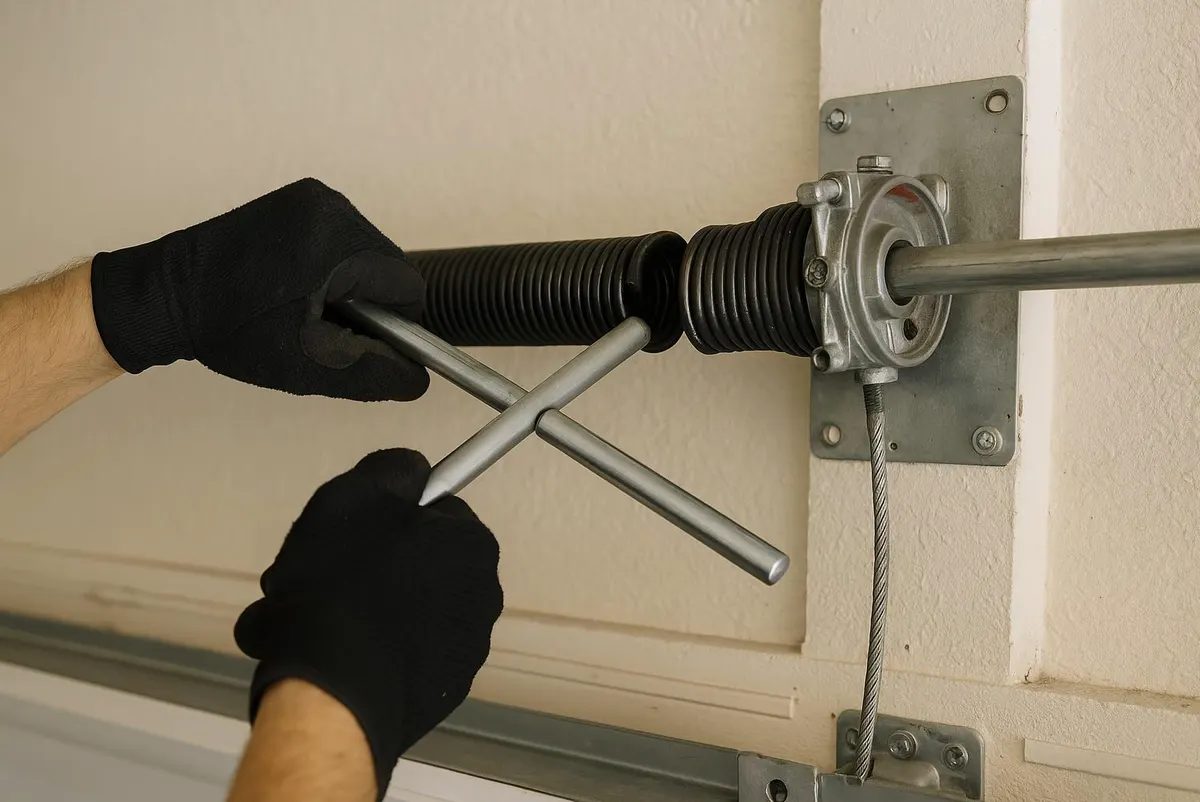
If the door won't lift manually, even with the opener disconnected, a broken torsion or extension spring is the likely culprit. You may see a visible gap in a torsion spring above the door, or hear a loud bang at some point, often first thing in the morning when the metal has cooled overnight. Springs carry the full weight of the door and are under serious tension, so this is not a DIY fix. Replacement means matching the correct spring size and wind for the door's weight, which also matters for meeting Florida's wind-load expectations on garage doors.
6. Cables and Drums
Next, a technician looks at the lift cables running alongside the tracks. Fraying, slipping off the drum, or snapping outright will keep the door from moving evenly or at all, and often causes the door to hang crooked on one side. Salt-laden air near the coast accelerates corrosion on these cables, so homes closer to the water tend to see this wear sooner.
7. Track Alignment and Rollers
An off-track door is often obvious: a visible gap between the roller and track, or the door binding partway through its travel. Humidity swings can also cause wood panels or frames to swell slightly, which puts extra pressure on rollers and tracks. Realigning the track and checking rollers for wear or rust is the fix here.
8. Opener Gear and Limit Settings
If everything mechanical checks out but the opener still hums without moving the door, the internal drive gear may be stripped, which is common on older units. Incorrect limit switch settings can also cause the door to stop short or reverse unexpectedly, which is adjustable without replacing the whole opener.
Why Fort Myers Weather Adds Extra Wear
Heading deeper into fall still means humidity, salt air for coastal properties, and the occasional late-season storm system. Moisture speeds up rust on springs, cables, and rollers, swelling can throw panels and tracks slightly out of alignment, and power blips from storms are a common reason openers need their settings or sensors rechecked afterward. None of this means a new door is needed, it just means these parts wear faster here than they would in a dry, inland climate.
When to Call Fort Myers Garage Door Pro
If your door won't lift by hand, you see a gap in the torsion spring, or a cable looks frayed or snapped, stop trying to force it and call us. Our garage door spring repair handles the dangerous, tension-loaded part of the job safely, and if cables have gone with it, we handle garage door cable repair at the same visit so the whole lift system is back in balance. If the door is simply misbehaving, stopping short, reversing, or hanging crooked, we can also run a full tune-up and check sensors, tracks, and opener settings in one visit before small issues turn into a no-open emergency.
If your garage door in Fort Myers, FL isn't opening, don't keep pulling the cord and hoping. Call Fort Myers Garage Door Pro for fast, reliable service across Fort Myers, Cape Coral, Lehigh Acres, North Fort Myers, Estero, Bonita Springs, San Carlos Park, and Gateway.